

Go to New Games



Rooftop Flip
Advertisement
























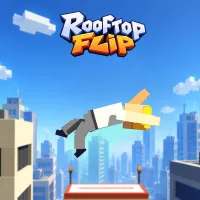
Rooftop Flip will throw players into unbelievable challenges. These spots can range from massive skyscrapers and cranes to speeding truck roofs. Moreover, this title will draw inspiration from street parkour and funny ragdoll physics. Each level may only last a few brief seconds, yet it will feel breathtaking. Therefore, gamers must always adjust every spinning angle in mid-air. If you miss by a tenth of a second, the character will tumble down. Keep landing successful flips and gathering lots of gold coins.
STEP-BY-STEP PLAYTHROUGH
Entering the first level, players will see the character standing on a skyscraper roof. He will get ready to flip down onto a lower building. To prepare, you need to click and hold the left mouse button. Then, gamers have to let go so the jumper can leap up. When his legs point straight down at the ground, users should click again. Thus, he will land safely on both feet. Once familiar with the mechanics, you can click repeatedly in mid-air to spin non-stop. As the flip technique gets harder, players will earn a much higher score.
Game highlights
- Diverse jumping settings: Apartment roofs, stacked containers, train tops, moving trucks, and sci-fi spaces.
- Gold coin collection: Shiny coins encouraging higher leaps and more mid-air spins.
- Funny character roster: Using saved coins to unlock unique skins like a Ninja, Sumo wrestler, Panda, Penguin, Monkey King, or Astronaut.
Mouse controls
- Click and hold the mouse to aim the jump angle and power.
- Let go to launch the character into the air.
- Click the mouse once more to land safely on both feet.
Parkour secrets of Rooftop Flip
- Aim for a launch angle of 45 to 60 degrees to create the best arc.
- Release the button when the body finishes about three-quarters of the final spin.
- Avoid greedily chasing coins before mastering the jump distance.
- Prioritize staying alive and hitting the safe center when entering a new stage.
- Limit spinning too many times when aiming for moving surfaces.